

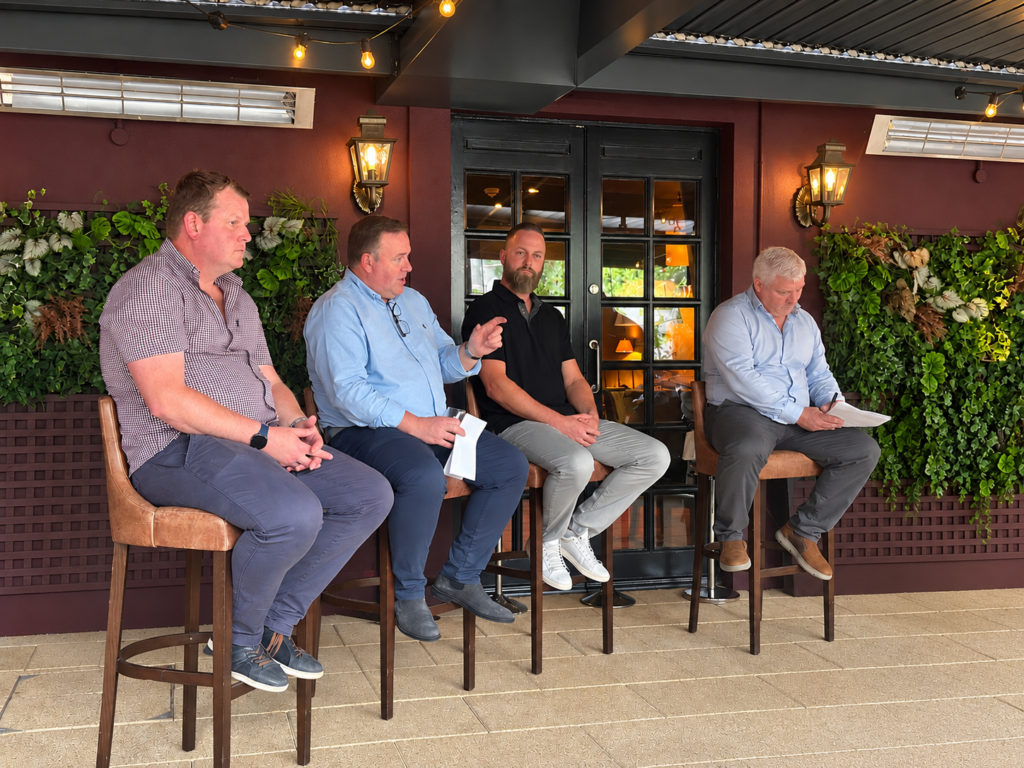
Last week, we brought together stakeholders from across the data centre and construction industries for a Health and Safety Leaders Lunch and Panel, including customers, prospects and some genuine titans of the industry: Francis Kelly, Andrew Dunne, Jason Crowell and Mick O’Connor.
The conversation centred on three words: coordination, communication and competence. We wanted to understand the real challenges facing health and safety in construction today, and how we tackle them together. What followed was one of the most honest, unfiltered discussions we’ve hosted, and one line captured the crux of it:
“If we can deliver safety, we will deliver quality, we will deliver on time and we’ll get repeat business.”
Meet the Panel
Mick O’Connor is a Group QEHSS Director with 25 years of experience across EMEA, spanning data centre, pharma, commercial and healthcare projects. He’s built digital permit systems and industry-wide training programmes, and now runs his own Environmental, Health and Safety consultancy.
Francis Kelly is a Health, Safety and Environment Advisor at Cairn Homes PLC, with a background in the utilities sector and an MSc in Environmental Science from University College Dublin.
Andrew Dunne is Global Vice President of Health & Safety for EdgeConnex, bringing over 30 years of HSE and ESG leadership across tunnelling, data centre and waste-to-energy projects in Ireland, the UK, Scandinavia, Australia, the USA and South Korea.
Jason Crowell is Director of Environmental, Health and Safety at Burr Computer Environments, with over 20 years in QHSE across the Oil and Gas and Construction industries.
Key Takeaways
 Effective co-ordination is crucial for ensuring safety and driving productivity
Several panellists linked poor sequencing, missed hold points and rework directly to safety incidents, with roughly 40% of accidents happening during rework, usually due to a disconnect between scheduling teams and what’s happening on-site. The suggestion was to bring safety into the conversation as early as the land-purchase stage.
There’s a communication gap between the office and the workers on site.
Systems, plans and meetings can all be in place at leadership level, but that doesn’t guarantee the message reaches the people doing the work. As Jason put it: “Everybody’s singing from the same sheet of music. And then you go and talk to a guy on the tools, and he has no clue what’s going on.”
Competence on paper is different to competence in practice.
A card or certification proves someone passed a test, not that they can safely do the job in front of them today. The industry has shifted from “do they have a card” to “can they actually do the job,” an unresolved challenge worth thinking about moving forward.
Schedule pressure quietly undermines safety.
Companies say safety comes first, but deadlines and commissioning pressure often creep in ahead of it. One panellist recalled being told a project was “53 days behind” before ground had even been broken.
Blame doesn’t fix anything, behaviour does.
A meeting run in a blame-driven way is never productive, no matter how good the planning tools behind it are. One panellist described a construction manager still “hitting the table with his spreadsheet.” It was only once he saw feedback on how those meetings were perceived that he changed his approach, and the dynamics transformed.
The wider point was about psychological safety: when people can raise issues without fear of blame, conversations become more honest and more productive.
Promoting your best tradesperson doesn’t automatically make a good supervisor.
Several panellists referenced the “Peter Principle”: people get promoted into management for being excellent technicians, not for their ability to manage people. Without proper training and transition time, this creates weak links in the communication chain.
Nobody trusts safety statistics as much as we’d like to think.
One panellist called statistics “the elephant in the room” and questioned who they’re really generated for: client optics, or genuine insight into what’s happening on the ground. A better signal, several agreed, is direct, honest feedback from workers themselves, even when uncomfortable to hear.
What We’ve Learned
If there’s one idea that ties the discussion together, it’s this: most organisations don’t lack safety systems. They have a gap between what’s designed at the top and what happens on the ground.
Closing that gap means clear communication, better co-ordination between people systems, and accepting that competence can’t be fully verified on paper. It means bringing safety into the conversation early, not once the schedule is already set.
Above all, it means listening. As Francis put it:
“You have to look for feedback, you have to hear it, and you have to take it on.”
We’re grateful to Francis, Andrew, Jason and Mick for such a candid conversation, and to everyone who joined us.