

In construction, safety incidents are often explained in familiar terms. Human error. Lack of competence. Failure to follow procedures.
These explanations are convenient, but they are rarely complete.
When incidents are examined more closely, whether they result in a near miss, an injury or a serious event, a different pattern often emerges. The people involved were trained. The method statements existed. The controls were documented. Yet something still went wrong.
More often than not, the underlying cause is not competence, but coordination.
Safety failures are rarely competence failures
Construction sites are full of skilled professionals. Inductions are completed, permits are issued, PPE is worn and method statements are briefed. Despite this, incidents continue to occur across projects of every size and complexity.
The reason is simple, even the most competent worker is exposed to risk when work is poorly coordinated.
Conflicting activities taking place in the same area, tasks starting before preceding work is truly complete, permits issued without awareness of adjacent operations, or crews arriving on site without clarity on what has changed since the last shift, these are the conditions that create danger. In each case, the issue is not individual behaviour, but a breakdown in how work is planned, sequenced and connected.
These are systemic coordination failures, and they are one of the most consistent contributors to site incidents.
Activity coordination is already your main safety control
Every construction project relies on coordination to remain safe. Work has to be sequenced, interfaces managed and risks communicated. Planning meetings, permits and access systems all exist to support this.
The difference between safer and riskier sites is not whether coordination exists, but how visible, controlled and connected it is.
Where coordination is informal, fragmented or reliant on memory and paper-based processes, risk increases. Information is lost between teams, assumptions are made, and hazards remain unmanaged until it is too late. Where coordination is structured, shared and continuously updated, risk is actively reduced as part of day-to-day operations.
In this sense, coordination is not just an operational activity, it’s a frontline safety control.
The visibility gap that creates unnecessary exposure to risk
One of the biggest contributors to safety risk on site is a lack of visibility.
When site teams cannot clearly see who is on site, what they are authorised to do, where high-risk work is taking place and how activities overlap in time and space, exposure increases. Hazards go unmanaged not because teams do not care, but because they do not have the right information at the right time.
Integrated workforce management and site access systems play a critical role here. Clear, real-time visibility enables contractors to control access to high-risk areas, prevent overcrowding, verify that the right competencies are present and respond quickly when conditions change.
Visibility does more than support compliance. It actively prevents people being in the wrong place at the wrong time, one of the most common precursors to incidents.
Interfaces are where risk concentrates
Many serious incidents do not occur within a single task, but at the interface between tasks. Mechanical works overlapping with electrical installation, commissioning beginning while construction activities are still underway, or maintenance teams entering live environments without full context are all examples of this.
These interfaces are inherently risky because responsibility is shared, conditions change rapidly and assumptions are easily made. They cannot be effectively managed through paperwork or siloed conversations alone.
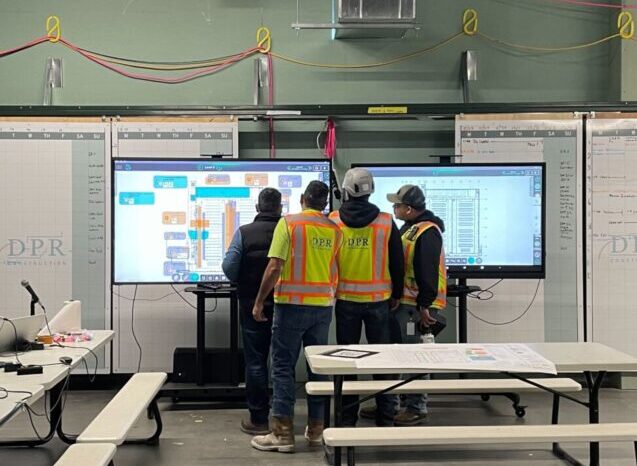
Controlling interface risk requires shared planning, clear ownership and visibility of constraints across teams. Digital activity planning tools such as DataTouch help make these interfaces visible before work starts, allowing risks to be identified and managed proactively rather than discovered during execution.
When work is rushed, safety suffers
Poor coordination inevitably creates pressure. Delays stack up, programmes slip and teams feel compelled to recover time.
This pressure leads to rushed tasks, shortcuts and controls being bypassed; not out of negligence, but as a response to unstable working conditions. In these environments, even well-designed safety processes struggle to hold.
In contrast, well-coordinated and lean sites create flow. Tasks start when they should, crews are not stacked or waiting on each other, and sequencing is respected and understood. The working environment becomes more stable and predictable, which significantly reduces the likelihood of unsafe acts or conditions.
Lean construction is often discussed in terms of productivity, but its impact on safety is just as important. When work flows, safety improves.
Digital coordination connects people, plans and processes
Modern construction projects are too complex to manage coordination through disconnected systems and manual processes alone. As projects scale and interfaces multiply, the risk created by fragmentation increases.
Platforms like DataScope support safer delivery by connecting workforce management, lookahead planning, permits and daily activity coordination into a single operational view. This allows site teams to see who is on site, what work is planned, where constraints exist and how activities interact in real time.
The value of this approach is not better reporting for its own sake, but better decision-making on site. When information is shared and visible, teams can prevent clashes, control access, sequence work effectively and respond quickly to change.
Safer sites stem from better-coordinated sites
Improving safety performance does not always require more rules, more paperwork or more training. Often, it requires better coordination. Clear visibility of people and activities, controlled access to risk, lookahead planning and predictable work flow all contribute to safer site conditions. When people, plans and processes are properly connected, risk is reduced naturally, not through enforcement, but through better ways of working.
Safety failures are often coordination failures. Recognising this is a critical step towards improving safety outcomes across construction projects.
Safer sites are better-coordinated sites, and better coordination remains one of the most powerful, safety controls in the industry.
Speak to DataScope today to see how connected planning and workforce visibility can help you build safer, more predictable sites.