

The part of the data centre boom you don’t see
With the AI industry growing at the pace it is, data centres are rarely out of the headlines. There is new investment, new campuses, new capacity announced almost every week. But what gets far less attention is what that growth means for the people actually building them.
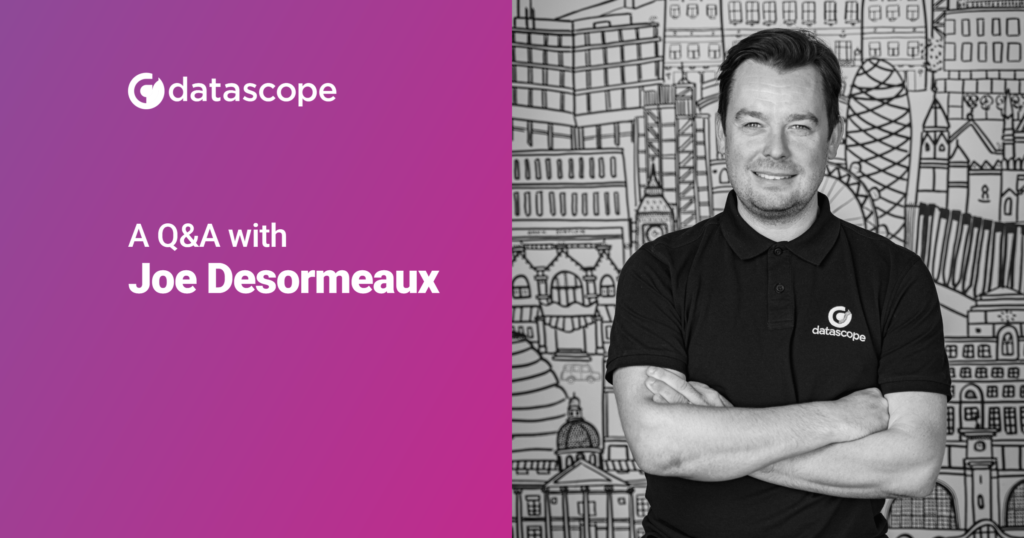
Joe Desormeaux, VP Mission Critical at DataScope, works with project leads on data centre builds across Europe, Asia and the Americas. We sat down with him to talk about what’s really happening on these sites, where the risks sit, and what contractors can do to stay in control as the pace keeps rising.
We started with the obvious question: what’s going on in this market that people outside it might not appreciate?

As DataScope’s VP Mission Critical, Joe Desormeaux reflected:
“Behind the investment headlines and the project announcements, there’s massive pressure on the teams delivering these projects, with tighter programmes and more risk.”
With more risk comes a greater need for safety and compliance. The conversation tends to focus on capacity and capital, but whether a data centre is delivered safely, on time and to standard is decided by the teams carrying that pressure every day.
If the growth is going to hold up, the industry has to look closely at how those teams are supported, and whether the right systems and processes are in place to back them.
More projects, more spaces, same standards
The hard truth is that the rapid growth of data centres puts standards under strain. Projects are multiplying faster than the people and resources available to deliver them, yet every site still has to be held to the same standard. For Joe, keeping that bar consistent comes down to process.
“Teams need to deliver more projects, across more locations, while maintaining consistent standards and meeting local requirements. We’ve seen that consistent processes help them stay in control and apply lessons learned from one project to the next.”
Growth also puts pressure on the most limited resource of all: good people. Experienced project managers, site leads and safety professionals are needed on every major programme, and there are only so many to go around. The teams that keep them are the ones that give them the right tools, clear processes and the space to do their best work.
“Because of the growth, good people are in demand. We’ve worked with some amazing people on data centre projects across the globe. The best ones are always looking to improve, and they challenge both us, as a solutions provider, and the project teams to be the best. In all honesty, that’s why I love this sector. It’s always challenging, and it’s always trying to improve.”
Why a data centre build is different
So, what actually makes these projects different? On paper, a data centre build can look like any other large construction project.
But in practice, the number of trades on site at once, the pace of the programme and the amount of electrical and commissioning work make it a very different job to manage. For Joe, it comes down to two things.
“It’s the scale and the coordination involved. Multiple contractors, thousands of workers carrying out interdependent activities. Connecting that workforce, the safety, the logistics and the planning helps those teams make sure the right people, materials and approvals are in place.”
It’s easy to see all that coordination as a planning exercise, but Joe is clear that it serves something more fundamental. Behind every schedule, permit and delivery slot is a person who needs to get through their shift safely.
Everyone should have the tools and information to do their job safely and to the best of their ability, and at the end of the day, go home safe to their loved ones. That’s the whole goal in what we’re trying to deliver.
Where the risk sits
In the world of construction, scale brings risk with it. Every data centre build carries a heavy load of high-risk activities (HRAs), often happening at the same time and in the same spaces. With multiple contractors working side by side, one team’s work can quickly create hazards for another.
“There are plenty of high-risk activities. Lifting, working at height, vehicle movements, commissioning, electrical works. They all need careful management, particularly when activities overlap and when site conditions change.”
Managing that overlap depends on visibility. Teams need to know what high-risk work is happening, where and when, before it starts. Joe points to one change in particular, driven by the Microsoft High Risk Activity Initiative: building high-risk activity visibility into DataTouch, DataScope’s daily activity briefing and site coordination tool.
“Building high-risk activity visibility into DataTouch was a catalyst for better coordination. We saw a significant increase in engagement between trades. Teams discussing the risks and planning the works together. Reducing those risks is massively important.”
When every trade can see high-risk work in one place, safety stops being something each contractor manages alone and becomes a shared conversation.
Safety culture before it’s a system
Managing risk is one part of the picture. Keeping people safe and compliant day to day is another. When we asked Joe what extra precautions data centre sites need, he started with the basics, not the software.
“Safety starts with competent people, having the correct RAMS and permits in place, and clear communication. Congested areas, overlapping activities, commissioning: they all need close coordination.”
Technology plays an important part, but Joe is honest about its limits.
Technology helps us capture the data, learn from it and identify concerns earlier. But people are human and mistakes happen. Building a safety culture from the start, where everybody buys into the processes, uses the tools and feels confident speaking up, that’s key in all of this.
It’s a useful reminder. Tools can capture data and flag concerns early, but they only work when the people using them believe in what they’re for. Safety works best when everyone on site, from project leads to operatives, feels responsible for each other.
From one site in Amsterdam to entire portfolios
DataScope’s own story in data centres started with a single project, and it has grown alongside the industry since.
“We started in the data centre sector back in 2016 in Amsterdam, working with one of our strategic partners, Mace, on a Microsoft project. Since then, we’ve been written into client tender specifications. We’ve worked with some fantastic partners across Europe and Asia, including Jakarta and Singapore, over in the US, and further afield in Santiago, Chile.”
Being written into client tender specifications shows how much clients have come to rely on that track record.
“There have been some challenges along the way, but it’s been an amazing journey. We’ve grown from solving individual site problems to supporting entire portfolios, and we feel like we’re just getting started.”
Making every project improve the next
So where does it go from here for Tier 1 contractors? Joe returns to an idea that runs through the whole conversation: lessons from one project should make the next one better. Too often, what a team learns on site leaves with them when the project closes out.
“The opportunity is to make every project help improve the next. An integrated ecosystem brings safety and productivity together while connecting the data. AI can help teams spot recurring delays and emerging risks. Used together, the solutions give contractors greater certainty across their projects and portfolios.”
For Joe, the real value is in how the pieces connect. Planning, safety and workforce information often sits in separate places, but it becomes far more useful when each one informs the others.
“Using the planning software to improve safety. Using the safety software to improve the lives of the people on site. Making sure they’ve got the right tools to go out and do the work safely. That’s where I see the future going.”
Then there’s the data itself. Every data centre build generates a huge amount of information, and Joe sees bringing it together as a major opportunity for the industry.
There’s a real insight opportunity in the huge amount of data we’re capturing across workforce, logistics, planning and safety. Connecting that information can help teams make better decisions and give contractors and client developers greater visibility across their portfolios, with AI building on those insights as the capabilities develop.
The takeaway
The growth of data centres is usually told through investment figures. On the ground, it’s a story about coordination: thousands of people, overlapping high-risk work and programmes that keep getting tighter.
The contractors who handle that best aren’t the ones with the most tools. They’re the ones with consistent processes, a safety culture people genuinely buy into, and connected data across planning, safety, logistics and the workforce. That way, what’s learned on one site makes the next one safer and more certain.